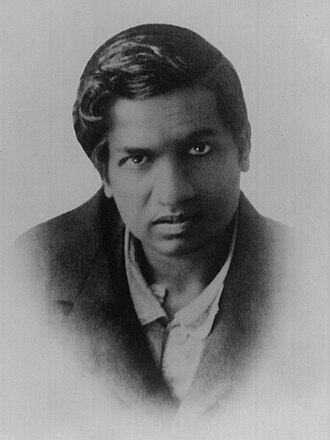
Born: 22 December 1887, Erode | Known for: ~3,900 results, taxicab number 1729, National Mathematics Day | Famous words: “An equation for me has no meaning unless it expresses a thought of God.”
Early Life
Srinivasa Ramanujan was born on 22 December 1887 in Erode, Tamil Nadu, into a poor family. At school he devoured a borrowed mathematics book and began discovering theorems on his own — filling notebooks with formulas no one had taught him. But he loved maths so completely that he failed his other subjects, lost his scholarship, and ended up a struggling clerk earning ₹30 a month at Madras Port Trust.
The Letter That Changed Mathematics
In 1913, Ramanujan mailed nine pages of his formulas to G.H. Hardy, a famous Cambridge mathematician. Hardy nearly threw the letter away — then looked closer and was stunned: these results 'must be true, because if they were not, no one would have the imagination to invent them.' Hardy brought him to Cambridge, where the self-taught clerk became a Fellow of the Royal Society — one of the youngest in history and among the first Indians.
The Man Who Knew Infinity
In five short years, Ramanujan produced nearly 3,900 results — many decades ahead of his time. Famously, when Hardy visited him in hospital and remarked that his taxi number 1729 was dull, Ramanujan instantly replied: 'No, it is a very interesting number — the smallest number expressible as the sum of two cubes in two different ways.' Such numbers are called taxicab numbers to this day. Weakened by illness and the cold English climate, he returned to India and died at just 32.
The Living Legacy
Ramanujan's 'lost notebook', found in 1976, keeps yielding treasures — his mock theta functions now help physicists study black holes, and his formulas power modern computer algorithms. India celebrates his birthday, 22 December, as National Mathematics Day. Hardy, asked his own greatest contribution to mathematics, answered without hesitation: 'The discovery of Ramanujan.'
What We Can Learn
- Genius can be born anywhere — a clerk's desk in Madras reached beyond Cambridge.
- One brave letter can change your life — send it.
- Follow your obsession, but don't neglect the rest of life the way exams punished him for.