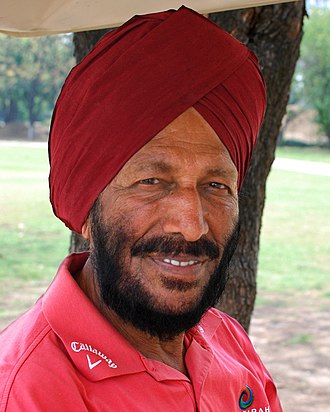
Born: 20 November 1929, Govindpura | Known for: Flying Sikh, CWG & Asian golds, 40-year record | Famous words: “I ran so hard that I would collect the sweat in my shoes.”
A Childhood of Fire
Milkha Singh was born in 1929 in a village in Punjab (now in Pakistan). During the Partition of 1947, as a teenager, he watched his parents and siblings killed in the violence — his father's last words to him were 'Bhaag Milkha, bhaag!' (Run, Milkha, run!). He ran for his life, reached Delhi orphaned and penniless, slept on railway platforms, and even spent time in jail for travelling ticketless.
The Army Makes a Runner
Rejected by the Army three times, Milkha got in on his fourth attempt in 1951. During a compulsory cross-country race, he finished sixth among 400 recruits — and earned extra milk and eggs for training. That small reward lit the fire. He trained so ferociously he would vomit and collapse, filling buckets with sweat, running until doctors warned him to stop.
The Flying Sikh
Milkha won gold at the 1958 Commonwealth Games — independent India's first athletics gold there — and golds at the Asian Games in 1958 and 1962. After he beat Pakistan's champion Abdul Khaliq in Lahore in 1960, Pakistan's President Ayub Khan told him: 'You didn't run, you flew' — crowning him The Flying Sikh. At the 1960 Rome Olympics 400m final, he made one fatal glance over his shoulder and finished fourth by a tenth of a second — his 45.6-second national record stood for almost 40 years.
The Legacy
Milkha called that Rome medal his life's one unfinished dream, and asked Indian athletes to win it for him. He gave his medals to the nation and refused money for his life story — the hit film 'Bhaag Milkha Bhaag' (2013) bought his rights for one rupee. He died in 2021, a symbol that no start in life is too broken to overcome.
What We Can Learn
- Your worst chapter can become your fuel — he turned 'run for your life' into 'run for gold'.
- Rejection is a comma, not a full stop: fourth attempt, then history.
- Never look back in your final stretch — literally and otherwise.