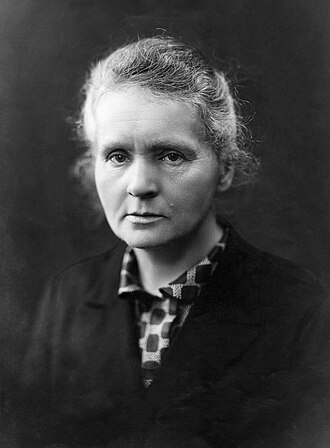
Born: 7 November 1867, Warsaw | Known for: Radioactivity, radium, two Nobel Prizes | Famous words: “Nothing in life is to be feared, it is only to be understood.”
Early Life
Maria Skłodowska was born on 7 November 1867 in Warsaw, Poland, then under Russian rule. Her family was poor, and universities in Poland did not admit women. So Maria made a pact with her sister: she worked for years as a governess to pay for her sister's studies in Paris; then her sister paid for hers. At 24, she reached Paris with a suitcase and a hunger to learn — she studied so hard she sometimes fainted, having eaten only bread and tea for days.
Discovering the Invisible
With her husband Pierre Curie, Marie investigated mysterious rays coming from uranium. In a leaky, freezing shed — their 'laboratory' — she stirred tonnes of black ore by hand for four years, boiling it down kilogram by kilogram. From it she pulled two brand-new elements: polonium (named for her beloved Poland) and radium, which glowed in the dark. She named the phenomenon radioactivity. In 1903 she became the first woman ever to win a Nobel Prize.
Tragedy and Triumph
In 1906 Pierre was killed in a street accident. Devastated, Marie took over his professorship — the first woman professor in the Sorbonne's 650-year history — and kept working. In 1911 she won a second Nobel Prize, in Chemistry. To this day, she is the only person to win Nobels in two different sciences. When World War I came, she built mobile X-ray vans — 'petites Curies' — and drove them to the front herself, helping treat over a million wounded soldiers.
The Price of Discovery
No one yet knew radiation was dangerous. Marie carried test tubes of radium in her pockets; her notebooks are still radioactive today, kept in lead boxes — visitors must sign a waiver to view them. The radiation slowly destroyed her health, and she died in 1934 of a blood disease caused by her own discovery. She had refused to patent radium, giving it free to the world: 'Radium belongs to the people.' Her daughter Irène won a Nobel too — making them science's greatest mother-daughter story.
What We Can Learn
- When doors close, build longer roads — the governess became the century's greatest scientist.
- Persistence looks boring: four years of stirring ore led to two elements.
- Share your gifts — she gave away what could have made her the richest woman alive.