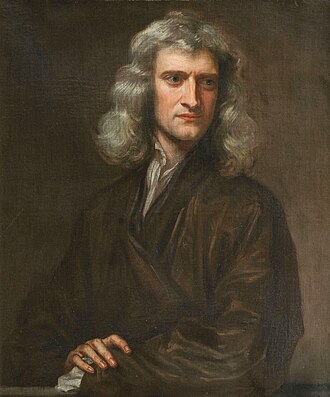
Born: 4 January 1643, Woolsthorpe | Known for: Gravity, laws of motion, calculus, Principia | Famous words: “If I have seen further, it is by standing on the shoulders of giants.”
An Unpromising Start
Isaac Newton was born on 4 January 1643 in Woolsthorpe, England — premature, fatherless, and so tiny they said he could fit in a quart mug. His mother wanted him to be a farmer; he was terrible at it, forever reading under hedges while sheep wandered off. An uncle rescued him for Cambridge University, where he initially earned his keep serving wealthier students.
The Miracle Years
When plague closed Cambridge in 1665, 22-year-old Newton went home for two years — and had perhaps the most productive isolation in human history. In that stretch he invented calculus, discovered that white light contains all colours, and — watching an apple fall (a story he told himself) — grasped that the same invisible force pulls the apple down and holds the Moon in orbit: gravity, one law for the whole universe.
The Principia
In 1687 he published the Principia Mathematica — often called the most important science book ever written. Its three laws of motion and law of universal gravitation explained everything from cannonballs to comets, and remained physics' foundation for over 200 years until Einstein refined them. Rockets to the Moon still fly on Newton's mathematics. He also built the first reflecting telescope — a design observatories use to this day.
The Human Newton
Newton was difficult — secretive, thin-skinned, feuding bitterly with rivals. Yet late in life he offered the humblest picture of genius: 'I have been only like a boy playing on the seashore... whilst the great ocean of truth lay all undiscovered before me.' And his most quoted line honours those before him: 'If I have seen further, it is by standing on the shoulders of giants.'
What We Can Learn
- Bad at the life others planned for you? You may be built for another.
- Guard your deep-focus time — two quiet years changed civilisation.
- Even giants stand on shoulders — credit your teachers.