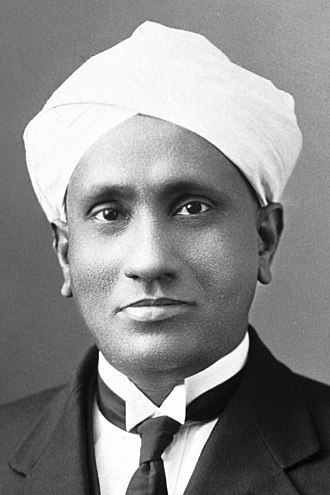
Born: 7 November 1888, Tiruchirappalli | Known for: Raman Effect, Nobel Prize 1930, National Science Day | Famous words: “Ask the right questions, and nature will open the doors to her secrets.”
Early Life
Chandrasekhara Venkata Raman was born on 7 November 1888 in Tiruchirappalli, Tamil Nadu, to a physics teacher father. A prodigy, he finished school at 11 and college at 16 with top honours. Since science jobs barely existed in British India, he became a finance officer — and did physics before and after office hours in a small Kolkata laboratory.
Why Is the Sea Blue?
On a ship voyage to Europe in 1921, Raman gazed at the Mediterranean and refused the textbook answer that the sea merely reflects the sky. Back home he proved the water itself scatters light. Chasing this thread, in February 1928 he discovered that light passing through any substance leaves with a slightly changed colour — a fingerprint of the molecules inside. This is the Raman Effect.
The Nobel — and the Tears
In 1930, Raman became the first Asian to win a Nobel Prize in science. So confident was he of winning that he booked his ship tickets to Stockholm months before the announcement. Yet at the ceremony he wept — because he saw the British flag, not India's, honouring his triumph. His discovery, made with instruments costing barely a few hundred rupees, today powers Raman spectroscopy — used to scan medicines, detect fake gems, analyse materials on Mars rovers, and screen for diseases.
Builder of Indian Science
Raman refused to let Indian science depend on the West. He led the Indian Institute of Science, founded the Raman Research Institute in Bengaluru, and trained generations of physicists. The day of his discovery, 28 February, is celebrated as National Science Day across India.
What We Can Learn
- Question even the textbook — 'why is the sea blue?' won a Nobel.
- World-class work doesn't need world-class budgets.
- Build institutions so the next generation starts ahead of you.